The WING KONG CHRONICLES
That how it always begins...very small....
Chapter One: The Two Dragons
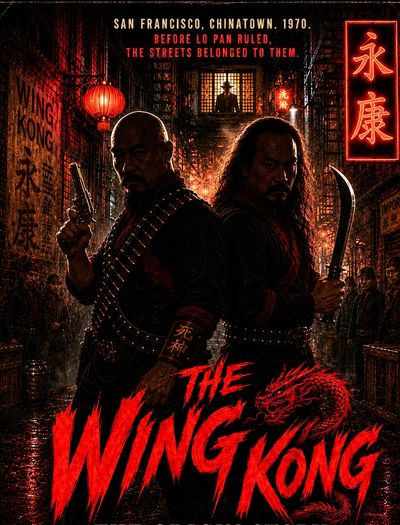
By the time Jack Burton stumbled into Chinatown in 1986, the Wing Kong organization had already become legend. To the San Francisco Police Department, it was simply another tong; a powerful Chinese criminal organization with deep roots in Chinatown. To the Chang Sing, however, the Wing Kong represented something far more dangerous. It was disciplined, organized, and utterly loyal to a mysterious benefactor who seemed to exist only in whispers. Few people knew that sixteen years earlier, the Wing Kong had consisted of nothing more than two young men with ambition, talent, and a willingness to embrace the darkness beneath Chinatown.
In the autumn of 1970, Chinatown was a neighborhood divided. Dozens of small crews fought over gambling houses, protection money, dock shipments, and the growing heroin trade moving through the Port of San Francisco. Alliances changed weekly, respect was earned with violence, and every alley seemed to belong to someone different. There was money to be made, but there was no order. Every tong believed it deserved to rule, yet none possessed the strength to unite the fractured underworld.
Gerald arrived in Chinatown with little interest in becoming a gangster. Quiet by nature, he spent his days moving from one martial arts school to another, absorbing everything he could learn. He trained relentlessly, studying Northern and Southern Chinese systems, weapons, locks, throws, and empty-hand combat with an almost obsessive discipline. Those who fought him quickly learned that his calm demeanor concealed extraordinary skill. He never looked for trouble, but when trouble found him, it rarely lasted long.
Al could not have been more different. Raised among Chinatown's narrow streets and hidden passageways, he knew every merchant, every gambler, every debt collector and every gang lieutenant worth knowing. He possessed an effortless confidence that drew people to him, and an instinct for reading others that often proved more valuable than a knife or a pistol. Where Gerald relied on discipline and precision, Al relied on personality, nerve, and the ability to seize an opportunity before anyone else recognized it.
Fate brought the two men together behind a modest mahjong parlor in Ross Alley.
Unknown to either of them, both had been hired to collect the same overdue gambling debt. Neither intended to leave empty-handed. What began as a heated argument quickly erupted into a fight that would become part of Chinatown folklore. Crates splintered, bottles shattered against brick walls, and curious spectators quietly gathered at both ends of the alley. Neither man gained a decisive advantage. Each time one appeared ready to finish the contest, the other answered with equal determination. For 30 minutes, both men fought with everything they had. By the time the fight finally ended, exhaustion had replaced hostility, and each recognized something in the other that was impossible to ignore.
Respect.
For most men, that would have been the end of the story. For them, it was only the beginning.
Watching silently from the balcony of a nearby tea house was an elderly man dressed so plainly that almost no one noticed him. Those who did seldom remembered his face afterward. He had observed the entire encounter without speaking a single word, studying not their techniques but their character. Strength interested him far less than loyalty, patience, and the willingness to stand one's ground.
Several nights later, both Gerald and Al received identical envelopes slipped beneath their doors. Inside each was a single sheet of rice paper bearing four carefully brushed words.
"Come beneath Chinatown tonight."
Neither invitation contained a name, an address, or any explanation. Yet both men understood enough about Chinatown to know that refusing such an invitation was rarely wise.
The tunnels beneath Chinatown had existed long before San Francisco had grown into a city. Hidden chambers, forgotten temples, abandoned passageways, and ancient meeting halls stretched beneath the streets like the roots of an enormous tree. Most residents knew only rumors of their existence. Very few had ever walked their corridors.
It was there, deep beneath the city, that Gerald and Al came face to face with the man who had quietly watched them from above.
David Lo Pan.
To the world above, Lo Pan was little more than an aging businessman with interests throughout Chinatown. Beneath the streets, however, his influence reached into every hidden corner of the district. He had watched generations of gangs destroy one another over territory while failing to recognize the greater prize: control. Chinatown did not need another gang. It needed an organization disciplined enough to outlast every rival and intelligent enough to remain hidden in plain sight.
Lo Pan saw in Gerald and Al two halves of a single leader. Gerald possessed unwavering discipline, exceptional martial skill, and the respect that could only be earned through action. Al possessed vision, charisma, and an instinctive understanding of power and influence. Individually, either man might have led a successful crew. Together, they could build something far greater.
Lo Pan made them a simple offer.
"Build an empire," he said quietly, "and let the world believe it belongs to you."
Neither man asked what he would receive in return.
Within months, small crews began disappearing from the streets. Some joined willingly, recognizing the advantages of unity. Others resisted and quietly faded into history. Gambling operations became organized. Smuggling routes expanded. Protection rackets operated with military precision. Every business owner in Chinatown eventually learned the same lesson: there was now one organization whose authority could not be questioned.
They called it the Wing Kong.
To outsiders, it appeared to be another tong struggling for influence.
To those who truly understood Chinatown, it had become something entirely different.
It was no longer fighting for territory. It was building an empire.
And somewhere beneath the city, hidden within the ancient tunnels that few would ever see, David Lo Pan smiled as the first pieces of a plan centuries in the making finally began to fall into place.